
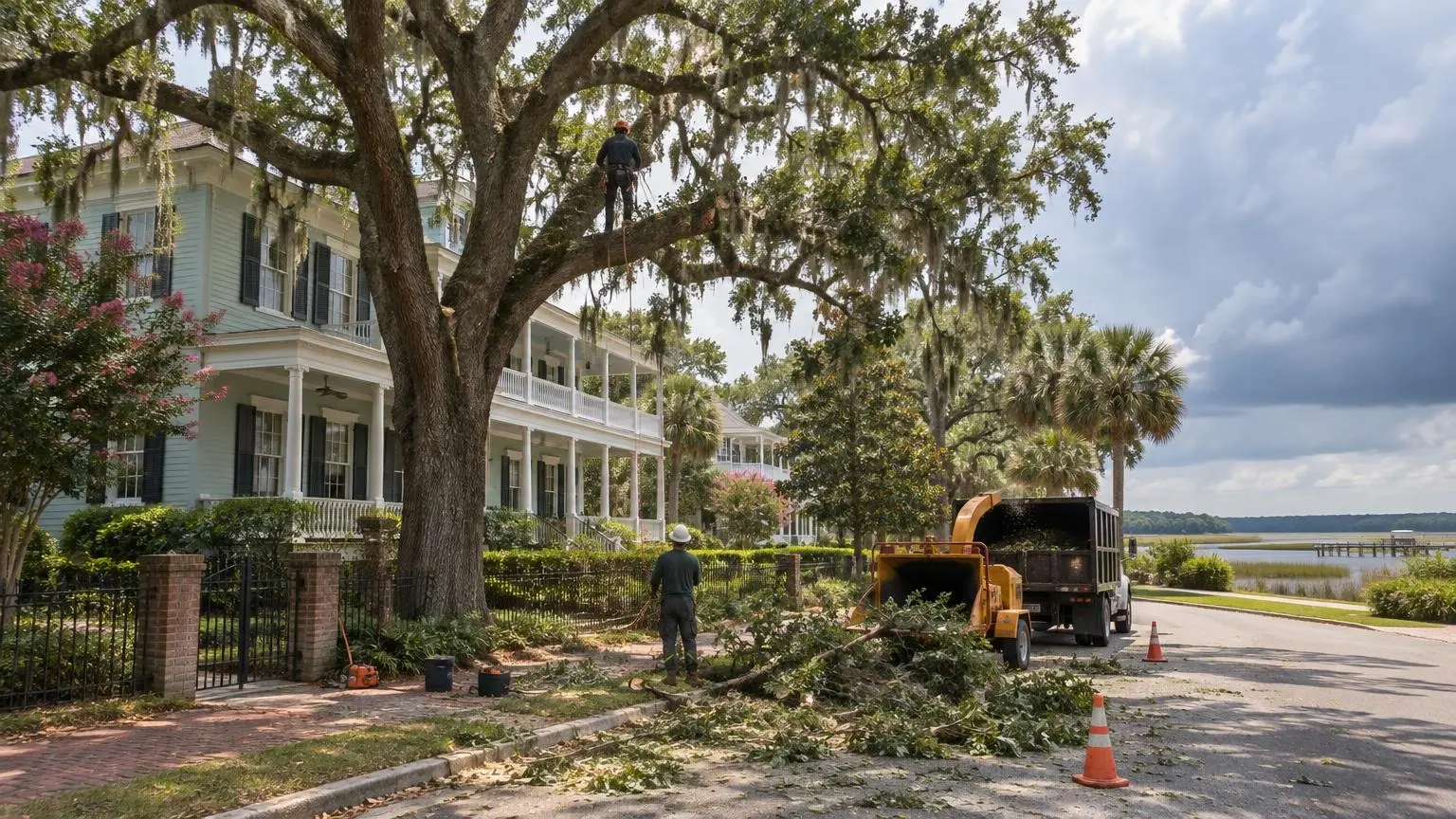
Hazard, dead and unwanted trees
Tree Removal in Charleston, SC
Taken down piece by piece over roofs and pools, with the permit question settled before anyone starts a saw.
- Free estimates, in person, for homes in Charleston and nearby towns
- Line-item quote you can compare
- Wood, brush and stump plan settled up front
When a Tree Has to Come Out
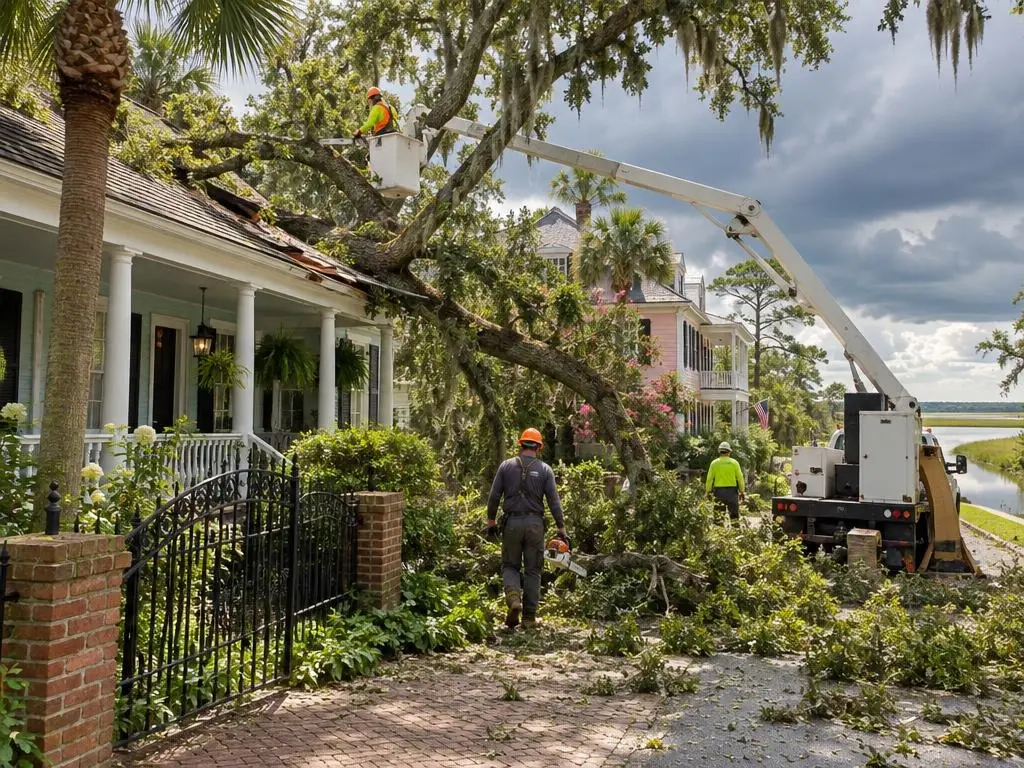
Tree removal in Charleston is often a two-part job: the paperwork question, then the cutting. Before quoting we measure the trunk at four and a half feet, because inside the city a tree 24 inches or more across, other than a pine or a sweet gum, is a grand tree and needs a city inspection and permit before it comes down. Smaller trees on single-family and duplex lots need no permit. After that, the job is about access and targets. Most yards here have a roof, a screened porch, a pool or a neighbor's fence under the canopy, so a tree is rarely dropped in one piece; a climber or a lift takes it down in sections, and heavy pieces are lowered on ropes.
Trees that usually should come out
Some cases are clear: a dead pine, an oak with a hollow trunk or shelf fungus at the base, a fresh lean with soil heaved up on one side, a split trunk after a storm. Laurel oaks deserve special attention. University of Florida research notes that they do not compartmentalize decay well, so old wounds and root damage turn into hollows, and older laurel and water oaks blow down more often in hurricanes. Many Charleston neighborhoods were planted with them decades ago, and some of those trees are near the end of their safe life. Clemson Extension also lists pines as only medium-low for hurricane resistance, and pecans as prone to blowing over.
Trees that may not need to come out
A healthy live oak is a different case. Clemson rates live oak among the most wind-resistant trees in the state, and many problems with one (a limb over the roof, roots near a walk, too much shade) can be solved with pruning. When a tree could be kept, we say so, and the quote shows both options if you want to compare.
Grand tree permits
The city approves removal of a protected or grand tree that is hazardous, diseased, irreparably injured, or damaging a habitable building where the damage cannot be fixed without removal. The process starts with a tree inspection request. If there is a question about hazard or disease, the Zoning Administrator may ask for documentation from an ISA Certified Arborist or another qualified person. Trees in an OCRM critical line buffer along the marsh cannot be removed. In unincorporated Charleston County, the county has its own protected and grand tree definitions and a permit application with a $25 residential fee.
Asian longhorned beetle and red maples
If you live in or near the Asian longhorned beetle quarantine in parts of Charleston and Dorchester counties, wood from host trees such as red maple, elm, willow, birch and sycamore cannot simply be hauled out. Firewood and host material half an inch or more across has to be processed under the rules or taken to an approved site inside the quarantine. We confirm your address against the current quarantine map before we cut, and the quote spells out where the wood goes.
What Is Included
Removal includes taking the tree down and dealing with everything that comes off it.
Sectional removal
Limbs and trunk sections cut from the top down and lowered on ropes over roofs, porches and pools.
Hazard and dead trees
Hollow laurel oaks, dead pines and storm-cracked trees taken down before they fail on their own.
Grand tree permit help
Trunk measured, inspection requested and the city's decision in hand before work is scheduled.
Wood and brush handling
Brush chipped, logs left in rounds or hauled, and host wood handled under quarantine rules where they apply.
Stump grinding add-on
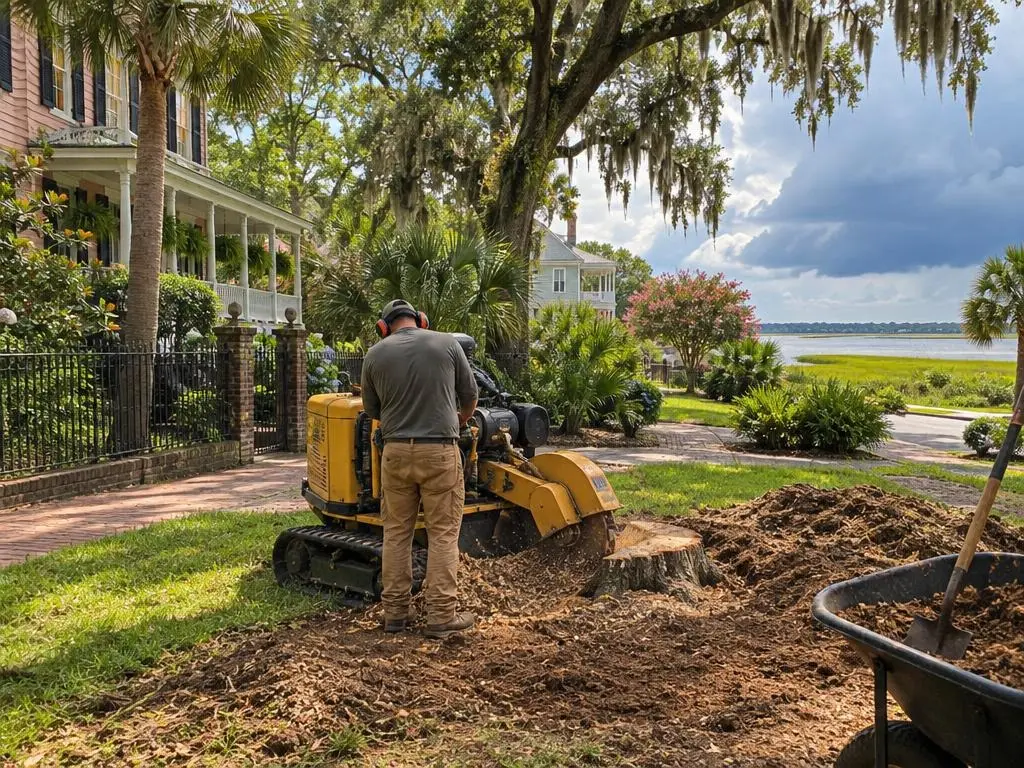
The stump ground below grade the same day or later, priced as its own line.
Typical Tree Removal Costs
| Job | Published range |
|---|---|
| Tree under 30 ft (HomeGuide) | $200 to $500 |
| Tree 30 to 60 ft (HomeGuide) | $500 to $1,500 |
| Tree 60 to 80 ft (HomeGuide) | $850 to $2,000 |
| Tree over 80 ft (HomeGuide) | $1,200 to $2,500+ |
| Oak (HomeGuide) | $300 to $2,500 |
| Pine (HomeGuide) | $250 to $1,600 |
| Stump add-on (HomeGuide) | $100 to $500+ per stump |
National figures from HomeGuide's 2026 tree removal guide. Large oaks over houses, tight access and dead or hollow wood cost more. Ranges are national figures from published cost guides, not local prices. Your written estimate is the price.
What to Expect
1. Visit and measure
We check the tree's health, measure the trunk, and look at targets, wires and access.
2. Permit check
If it is a grand tree or a city tree, we tell you and start the inspection request before scheduling.
3. Written price
Each tree, the method, the stump, the wood and the price, in writing.
4. Take it down
Sections come off from the top and are lowered where anything below could be hit.
5. Final cleanup
Brush chipped, wood handled as agreed, and the yard raked and blown off.
Tree Removal Questions
How much does tree removal cost in Charleston?
National guides put most removals between about $400 and $1,200, with tall trees over 60 feet from about $850 to $2,000 or more. A large oak leaning over a house or a pool will sit at the high end because of the rigging involved. We give a written price after seeing the tree.
Do pines and sweet gums count as grand trees?
No. The City of Charleston excludes pines and sweet gums from its grand tree definition, so on a single-family lot they need no removal permit at any size. They can still be protected trees on commercial lots, multi-unit lots and residential lots of an acre or more.
Will the city let me remove a healthy grand tree?
Usually not without a good reason. The city approves removal when the tree is hazardous, diseased, irreparably injured or damaging the house in a way that cannot be fixed otherwise. If your concern is shade or leaves, pruning is normally the answer.
Can I keep the wood?
Yes. Logs can be left in rounds or cut to firewood length. If your property is in the Asian longhorned beetle quarantine and the tree is a host species, the wood has to stay inside the quarantine or be processed under the rules, so we will tell you what is allowed.
What about a tree that is dead and dry?
Dead trees are less predictable to climb and cut, so they often take more rigging or a lift. Removing a declining tree before it is fully dead is usually easier and safer.
Tree Removal Service Areas
- Tree Service in Charleston, SC
- Tree Service in North Charleston, SC
- Tree Service in Mount Pleasant, SC
- Tree Service in Summerville, SC
- Tree Service in Goose Creek, SC
- Tree Service in Hanahan, SC
- Tree Service in James Island, SC
- Tree Service in Johns Island, SC
- Tree Service in Folly Beach, SC
- Tree Service in Isle of Palms, SC
- Tree Service in Sullivan's Island, SC
- Tree Service in Moncks Corner, SC
- Tree Service in Ladson, SC
- Tree Service in Ravenel, SC
- Tree Service in Hollywood, SC
- Tree Service in Kiawah Island, SC
- Tree Service in Seabrook Island, SC
- Tree Service in Lincolnville, SC
- Tree Service in Daniel Island, SC
- Tree Service in West Ashley, SC
- Tree Service in Awendaw, SC
- Tree Service in Meggett, SC
- Tree Service in Wadmalaw Island, SC
- Tree Service in Dewees Island, SC
Get a Tree Removal Estimate
Free tree removal estimates across Charleston.