
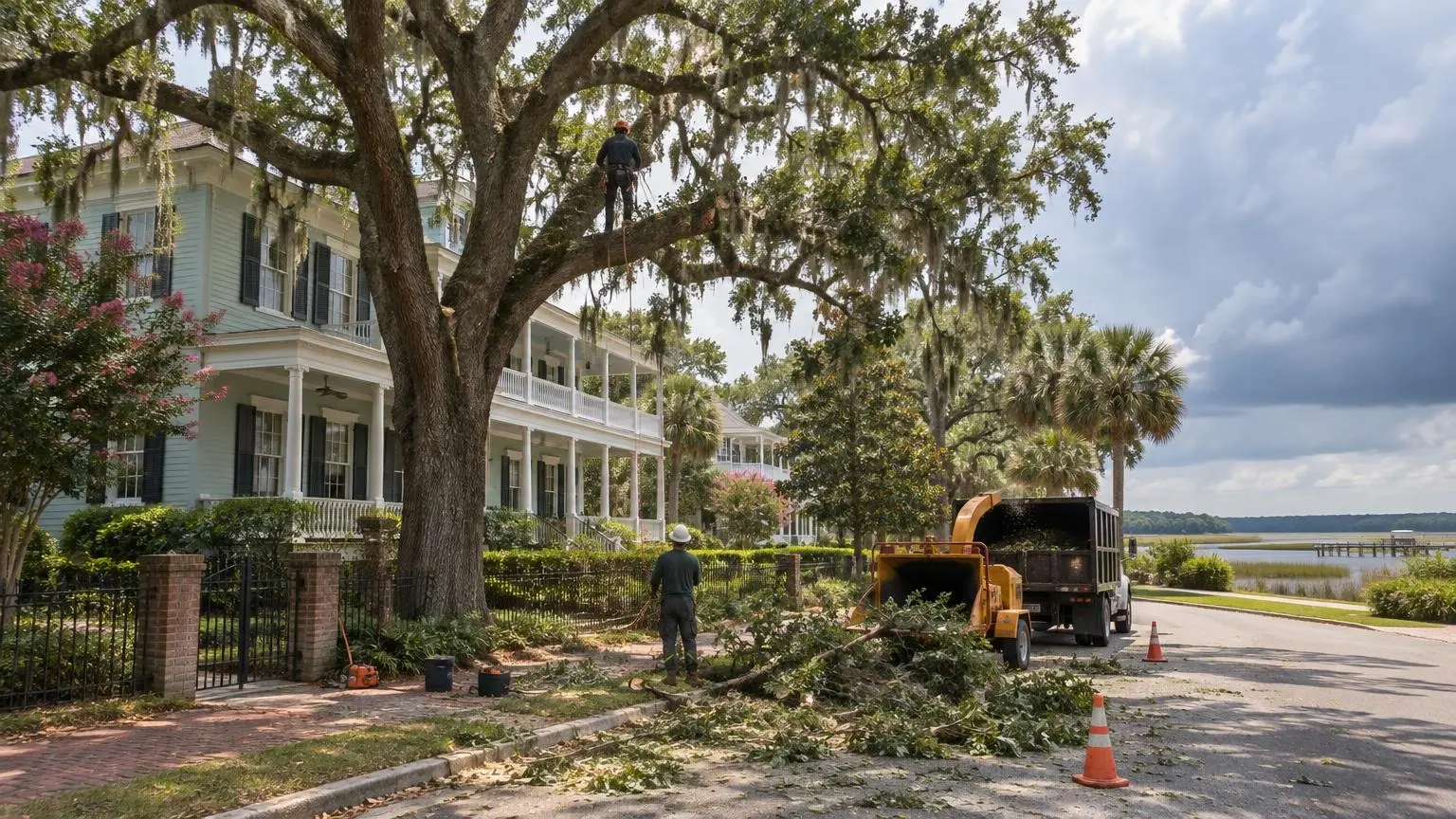
Between the Ashley and the Stono
Tree Service in West Ashley, SC
Care for the trees that have grown up over Avondale, Byrnes Downs, Windermere and the neighborhoods beyond.
- Free estimates, in person, for homes in Charleston and nearby towns
- Line-item quote you can compare
- Wood, brush and stump plan settled up front
Trees as Old as the Houses
Tree Service in West Ashley is mostly about trees that came with the neighborhoods. The first subdivisions west of the Ashley River were built in the 1950s, and the biggest wave of residential growth came in the 1970s and 1980s. Shade trees planted with those houses, along with pines left from the original woods, are now 40 to 70 years old. That's the age when laurel oaks and water oaks start to decline, pines get tall enough to reach the roof, and roots have spent decades working under driveways.
City or county?
West Ashley isn't its own town; it's one of the distinct areas of the City of Charleston, and most of it is inside city limits. A few pockets remain in unincorporated Charleston County, served by the St. Andrews Public Service District. That changes the tree rules. In the city, grand trees are 24 inches or more (pines and sweet gums excluded) and trees under 24 inches on single-family lots generally don't need a removal permit. In the county, grand trees are also 24 inches and up, and removals go through a county zoning permit. We confirm which side your lot is on.
Laurel oaks past their prime
Laurel oaks are common in mid-century Lowcountry neighborhoods because they grow fast and stay green most of the year. Their tradeoff is a shorter life than live oaks and a tendency to develop decay in the trunk and big limbs as they age. A 50-year-old laurel oak with fungus on the trunk, a hollow at an old pruning wound or heavy deadwood is worth having assessed. Sometimes careful reduction buys years; sometimes removal before the next storm is the responsible choice.
Pines over the house
Many West Ashley lots kept loblolly pines when they were cleared. Seventy years later those pines can be well over 80 feet tall, standing over roofs and the neighbors' yards. Pines aren't counted as grand trees under the city's definition, which gives owners more flexibility. Removing one in a tight backyard usually means climbing and lowering sections, or a crane where access allows.
History along the river
West Ashley holds some of the region's oldest landscapes. Charles Towne Landing, a 663-acre state historic site, preserves the location of the original 1670 English settlement, and Magnolia Plantation and Gardens is on the National Register of Historic Places. Ashley River Road, also listed on the National Register, runs through this side of the river. Living near that history, many owners want old trees kept if they safely can be, and we start from that preference.
Driveways, sewers and roots
Older neighborhoods have older clay sewer laterals and thinner driveways, and roots find both. Before removing a tree for root damage, it's worth knowing whether root pruning or a repair can solve it. We'll tell you what we see.
Request an estimate
Call (843) 202-4599 or use the form and tell us your neighborhood. We'll measure, look for decay and give you a written estimate. Get a free estimate
West Ashley Facts
- Mid-century neighborhoods. The first neighborhoods west of the Ashley were developed in the 1950s, with the largest residential and business growth in the 1970s and 1980s.
- Mostly city, some county. Most of West Ashley is within Charleston city limits; a few unincorporated pockets are served by the St. Andrews Public Service District and fall under county rules.
- Population. West Ashley's estimated population was 83,996 as of July 2022, bounded by the Ashley and Stono rivers and their marshes.
- Charles Towne Landing. The 663-acre state historic site preserves the location of the original English settlement established in 1670 at Albemarle Point.
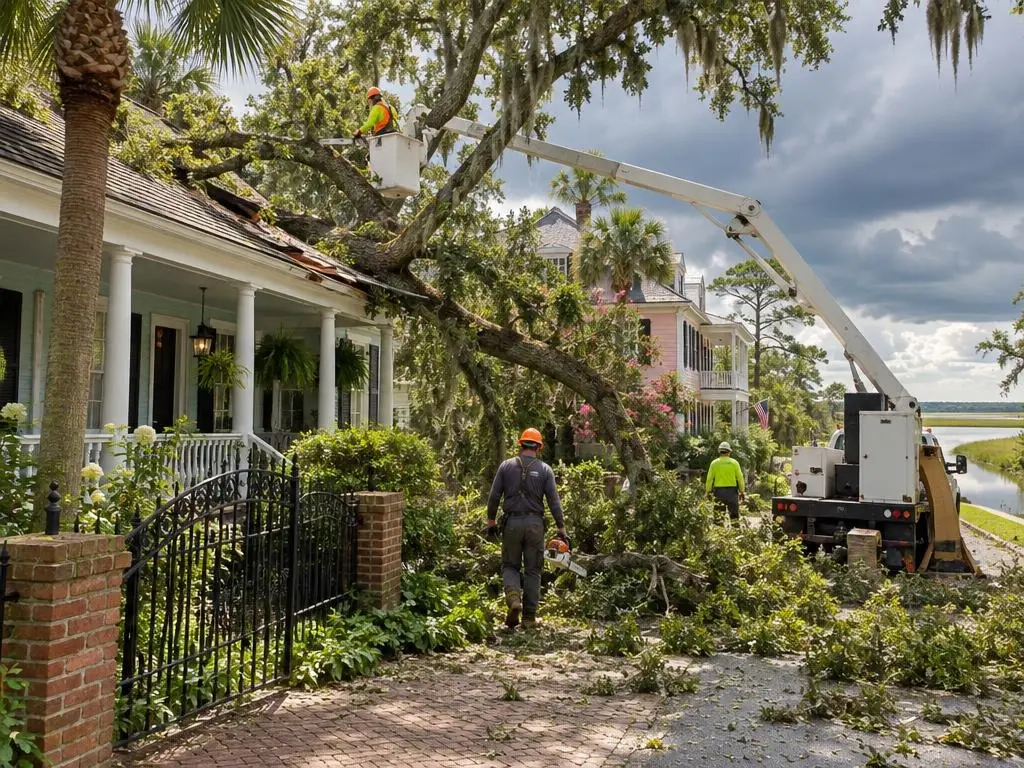
Our Services in West Ashley, SC
West Ashley Questions
Is my West Ashley house in the city or the county?
Most of West Ashley is in the City of Charleston, but some pockets are unincorporated. Your tax bill shows which, as does Charleston County's parcel map. The answer decides which tree permit rules apply.
My laurel oak has mushrooms at the base. Is that bad?
Fungi at the base often mean root or trunk decay. It doesn't always mean the tree must go, but it should be checked soon, especially if the tree leans toward the house.
Do I need a permit to remove a big pine?
Pines are excluded from the city's grand tree definition, and trees under 24 inches on single-family lots generally don't need a removal permit. If your lot is in the county or the tree is another species, check first.
Can roots be cut to save a cracked driveway without killing the tree?
Sometimes. Cutting roots well away from the trunk on one side is usually tolerated. Cutting close to the trunk or on several sides can destabilize the tree. We'll explain the risk before anything is cut.
Free Estimates in West Ashley, SC
Free estimates from Avondale and the Crosstown out to the Stono.
Tree Service Near West Ashley
- Tree Service in Charleston, SC
- Tree Service in North Charleston, SC
- Tree Service in Mount Pleasant, SC
- Tree Service in Summerville, SC
- Tree Service in Goose Creek, SC
- Tree Service in Hanahan, SC
- Tree Service in James Island, SC
- Tree Service in Johns Island, SC
- Tree Service in Folly Beach, SC
- Tree Service in Isle of Palms, SC
- Tree Service in Sullivan's Island, SC
- Tree Service in Moncks Corner, SC
- Tree Service in Ladson, SC
- Tree Service in Ravenel, SC
- Tree Service in Hollywood, SC
- Tree Service in Kiawah Island, SC
- Tree Service in Seabrook Island, SC
- Tree Service in Lincolnville, SC
- Tree Service in Daniel Island, SC
- Tree Service in Awendaw, SC
- Tree Service in Meggett, SC
- Tree Service in Wadmalaw Island, SC
- Tree Service in Dewees Island, SC