
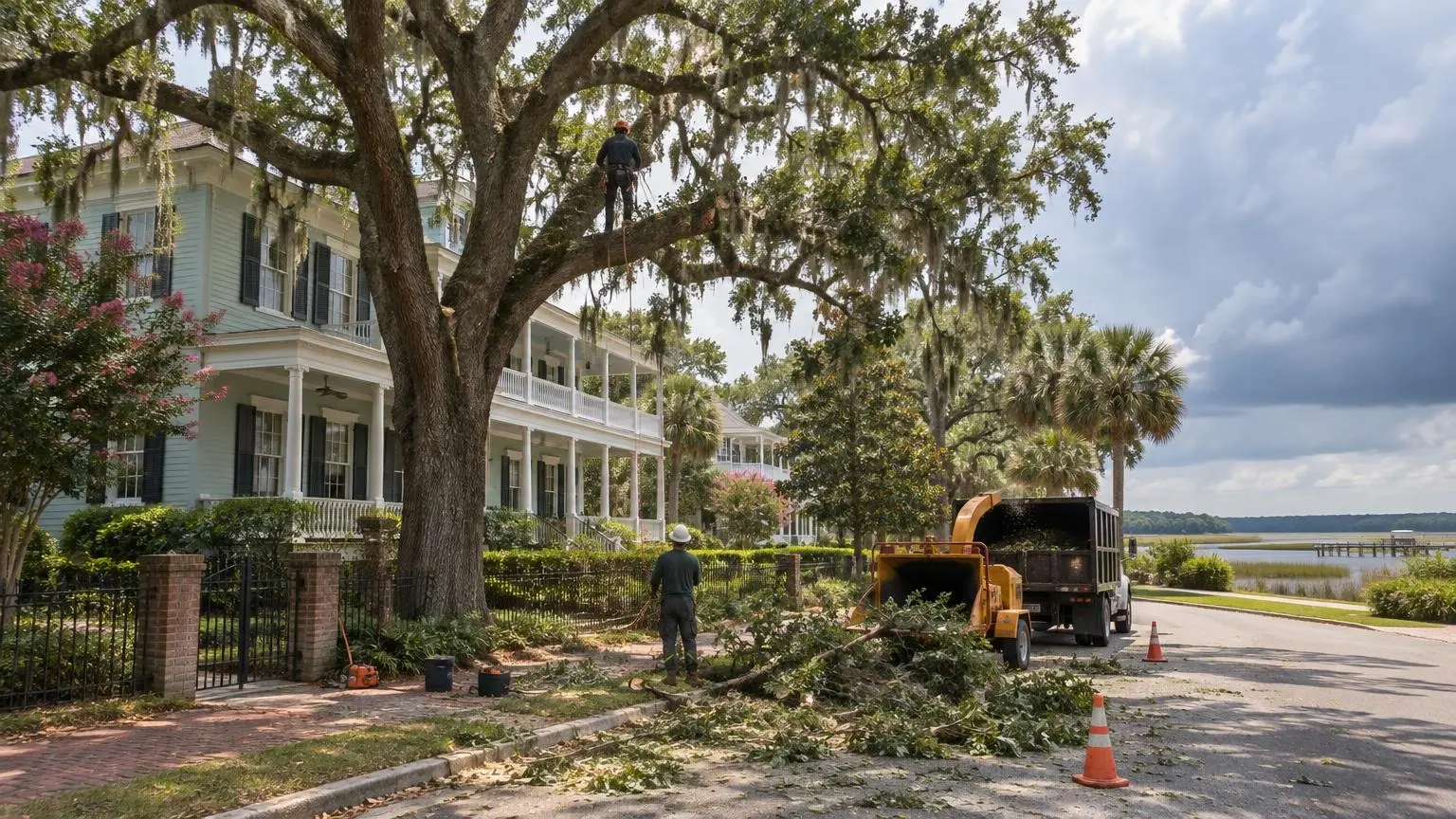
Home of the Angel Oak, on South Carolina's largest island
Tree Service in Johns Island, SC
Big oaks, long driveways and rural lots that need a different approach than city yards.
- Free estimates, in person, for homes in Charleston and nearby towns
- Line-item quote you can compare
- Wood, brush and stump plan settled up front
Trees on an 84-Square-Mile Island
Tree Service in Johns Island means working at a bigger scale than most of the Charleston area. At about 84 square miles, it's the largest island in South Carolina, separated from the mainland by the tidal Stono River. Much of it still feels rural, with farms along River Road, long dirt drives under oaks and wooded parcels where a single job might involve a dozen trees. We plan those jobs around access, soil conditions and how far the brush has to travel.
Living in the shadow of the Angel Oak
The Angel Oak, owned by the City of Charleston since 1991, is estimated at 400 to 500 years old. It stands about 66.5 feet tall with a trunk circumference of 28 feet, shades roughly 17,200 square feet, and has a limb reaching 187 feet. Hurricane Hugo damaged it badly in 1989, and it recovered. The lesson for homeowners with their own big live oaks: these trees can live a very long time if their long, low limbs are supported or lightened instead of hacked off. Live oaks can tolerate selective reduction well, but large flush cuts invite decay.
City lot or county lot?
Roughly one-third of the island is inside the City of Charleston and the rest falls under Charleston County. The county treats trees 24 inches or more in diameter as grand trees, excluding pine and sweet gum, and trees of 8 inches or more as protected. Its residential zoning fee for a tree removal permit is $25, and applications go through the county's online portal. The city's rules are similar at the 24-inch line but have their own process. We'll confirm which applies before quoting a removal.
Farmland edges and growth
Working farms on the island include Legare Farms, established in 1725. An Urban Growth Boundary in place since 1999 is meant to limit suburban expansion, but new neighborhoods keep arriving, and that's where we see the classic problems: oaks with roots cut by new driveways, pines left standing alone after clearing, and drainage changes that drown roots. If construction happened near your trees in the last few years, have them checked; decline often shows up three to five years later.
Power on the island
Berkeley Electric Cooperative serves parts of Johns Island; in June 2026 it restored power to about 3,000 members near Maybank Highway after an equipment failure. If a limb is resting on a co-op line, call the co-op's outage line. Don't let anyone without line-clearance training work within 10 feet of an energized line.
Estimates for small lots and big ones
Whether it's one oak over a cottage or a few acres of overgrown woods, call (843) 202-4599 or use the form. Tell us about gates, soft ground and how far the trees are from the drive. call (843) 202-4599
Johns Island Facts
- The Angel Oak. Estimated at 400 to 500 years old, about 66.5 feet tall with a 28-foot trunk circumference and a 187-foot limb; owned by the City of Charleston since 1991.
- Split jurisdiction. Roughly one-third of Johns Island is within the City of Charleston; most of the rest falls under Charleston County, which charges a $25 residential tree removal zoning fee.
- County grand trees. Charleston County defines a grand tree as 24 inches DBH or more, excluding pine and sweet gum, and a protected tree as 8 inches or more.
- Island size and growth limits. At about 84 square miles, Johns Island is South Carolina's largest island; an Urban Growth Boundary has been in place since 1999.
Our Services in Johns Island, SC
Johns Island Questions
Can you work on acreage with no paved access?
Usually. We'll walk the route during the estimate, check for soft spots and low limbs over the drive, and pick equipment that won't tear up the ground. After heavy rain we may wait a few days for things to firm up.
How should a big live oak be pruned on Johns Island?
Lightly and selectively. Remove deadwood, shorten the heaviest limb ends with reduction cuts, and keep clearance over roofs and drives. Avoid stripping the interior, which leaves weight at the tips and invites breakage.
Does Charleston County require a permit to remove a tree on my lot?
Grand trees (24 inches and up, other than pine and sweet gum) are protected under the county rules, and removals go through a zoning permit with a $25 residential fee. If your lot is in the City of Charleston, the city's process applies instead.
Can you clear underbrush and vines without taking the big trees?
Yes. Selective clearing removes undergrowth, vines and small volunteers while leaving the trees you want. It also opens up airflow and makes the remaining trees easier to inspect.
Free Estimates in Johns Island, SC
Free estimates from the Stono River bridges to River Road and Bohicket.
Tree Service Near Johns Island
- Tree Service in Charleston, SC
- Tree Service in North Charleston, SC
- Tree Service in Mount Pleasant, SC
- Tree Service in Summerville, SC
- Tree Service in Goose Creek, SC
- Tree Service in Hanahan, SC
- Tree Service in James Island, SC
- Tree Service in Folly Beach, SC
- Tree Service in Isle of Palms, SC
- Tree Service in Sullivan's Island, SC
- Tree Service in Moncks Corner, SC
- Tree Service in Ladson, SC
- Tree Service in Ravenel, SC
- Tree Service in Hollywood, SC
- Tree Service in Kiawah Island, SC
- Tree Service in Seabrook Island, SC
- Tree Service in Lincolnville, SC
- Tree Service in Daniel Island, SC
- Tree Service in West Ashley, SC
- Tree Service in Awendaw, SC
- Tree Service in Meggett, SC
- Tree Service in Wadmalaw Island, SC
- Tree Service in Dewees Island, SC